How to Teach the New AP French Language and Culture Unit (Without Starting from Scratch)


If you’re teaching AP French in 2026–2027, you’ve probably already opened the new Course and Exam Description, looked at the redesigned units, and thought:
Okay… but what am I actually supposed to teach?
The new Language and Culture unit is broad. Very broad: Customs. Linguistics. The Francophone world. Social media. Technology. Identity. Language evolution. Cultural perspectives.
The good news? You do not need to cover every possible topic connected to language and culture.
The real goal is to help students understand one big idea:
Language is not separate from culture. It reflects who people are, how communities evolve, and what they value.
The new framework organizes this unit around three essential questions:
How do language and culture influence each other?
How do language and culture evolve over time?
How does technology influence language and culture?
College Board also recommends exploring customs and celebrations, linguistics, and French throughout the world.
Here’s how I would approach it.
1. Build the Unit Around Questions, Not Vocabulary Lists
This is not the unit where students memorize a list of Francophone countries, learn ten expressions in verlan, and move on.
The topics are simply the entry point.
The real learning happens when students begin asking questions such as:
Who does the French language belong to?
Is there really one “correct” French?
Should institutions protect a language, or should speakers be free to transform it?
What does the way we speak reveal about our identity?
These questions create a thread between lessons that might otherwise feel disconnected.
A lesson about Québécois language laws connects naturally to a lesson about the Académie française. Verlan connects to youth identity. The pronoun iel connects language evolution to contemporary social debates.
Suddenly, the unit is no longer a collection of random cultural topics.
2. Show Students That French Does Not Belong Only to France
I’ll be honest: for many years, AP French courses still centered heavily on France.
This new unit gives us the perfect opportunity to challenge that.
French is spoken, adapted, protected, mixed, and reinvented across the world. Students should hear different accents, encounter local expressions, and explore the relationship between French and other languages.
They can examine:
the role of Africa in the future of the Francophonie;
the relationship between French and Creole in Haiti or the Antilles;
Québécois efforts to protect French in an English-dominant environment;
the use of nouchi, wolof, verlan, and local expressions;
the ways Francophone communities use festivals, music, and traditions to affirm their identities.
This is also where the unit becomes much more interesting for teenagers. Instead of studying French as something fixed inside a textbook, they begin to see it as a living language spoken differently by millions of people.
3. Make Every Authentic Source Do More Than One Job
The redesigned framework places a strong emphasis on culturally authentic sources. Students are expected to interpret audio, written texts, images, charts, and data while identifying audience, perspective, tone, and purpose.
But that does not mean every source needs to become a three-day comprehension packet.
A short video can lead to:
a listening activity;
a discussion about cultural perspectives;
a comparison with another Francophone community;
a short Project Q&A-style response;
and eventually, evidence for a written argument.
A chart about Francophone populations can become an inference activity before students even read the accompanying article.
An article about language policy can lead to a mini-debate:
Une langue doit-elle être protégée par la loi ?
The key is to move beyond basic comprehension.
After asking, “What does the source say?” add:
Why was it created?
What perspective does it represent?
What does it reveal about the community?
How does it connect to another source?
That final layer is where students begin developing real cultural understanding.
4. Practice the New AP Skills in Small Pieces
The redesigned exam includes a Project Presentation, a Project Q&A, and an Argumentative Essay. Together, the two project-based speaking tasks represent 35% of the exam score, while the essay represents another 15%.
That does not mean every lesson needs to become a full AP simulation.
In fact, I would not wait until the official project is released to begin practicing these skills.
After a reading or listening activity, ask students one spontaneous follow-up question and give them 40 seconds to answer.
Have them explain what a cultural practice reveals about a community’s values.
Ask them to summarize a source without reading directly from their notes.
Let them compare two Francophone communities using one similarity and one difference.
Before writing a complete essay, have them practice writing only a strong position statement or integrating evidence from two sources.
These short, repeated routines make the AP tasks feel normal. By exam season, students are no longer encountering an unfamiliar format. They have been building the same skills all year.
5. Choose Topics That Create Real Debate
Language is personal. That is what makes this unit so powerful.
Students usually have plenty to say about slang, generational language, texting, social media, accents, gender-inclusive language, and whether adults sound ridiculous when they try to use teenage expressions.
Use that.
Some of my favorite discussion questions for this unit include:
Le langage jeune enrichit-il ou appauvrit-il le français ?
Qui décide de ce qui est “correct” dans une langue ?
L’Académie française est-elle encore utile aujourd’hui ?
Une communauté peut-elle transformer une langue héritée de la colonisation et en faire la sienne ?
La langue peut-elle exclure certaines identités ?
There is no single correct response to these questions. That is precisely the point.
Students must interpret sources, consider cultural perspectives, develop an opinion, support it, and respond to someone else.
In other words: they are practicing AP skills without feeling like they are completing another test-prep exercise.
A Complete No-Prep Language and Culture Unit
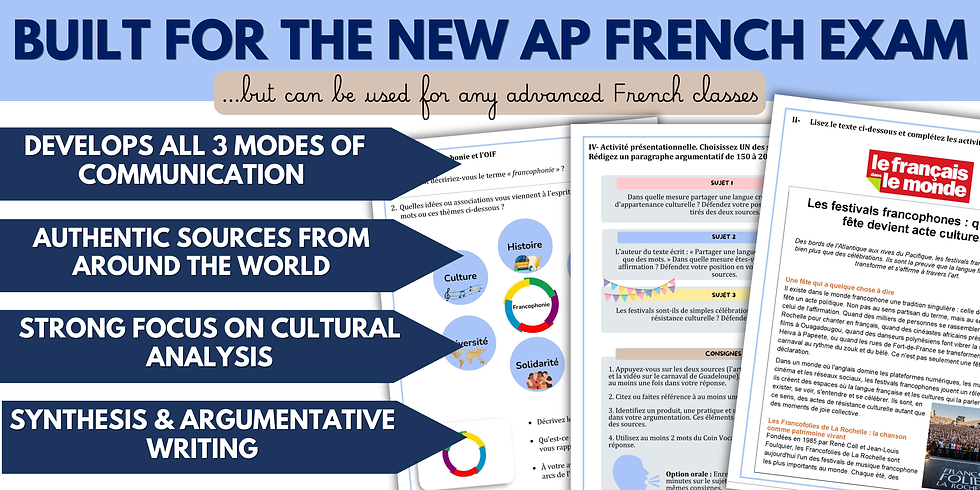
I created my own AP French Language and Culture unit because I wanted all of these pieces to connect — without spending my entire summer searching for sources, writing comprehension questions, and trying to align every lesson with the redesigned framework.

The unit moves from the global growth of French to questions of language ownership, Francophone varieties, Québec, youth language and verlan, the Académie française, the pronoun iel, and Francophone festivals.
Students work with readings, videos, audio, charts, vocabulary, cultural comparisons, discussions, debates, webquests, AP-style comprehension activities, Project Presentation and Q&A preparation, and argumentative writing. The complete 76-page sequence also includes its audio and video materials in a separate media folder.
What I especially love about this unit is that students are not just learning about French.
They are examining who speaks it, who shapes it, who protects it, and how it continues to change.
And for teachers, everything is already organized and ready to teach.
The new AP framework may look different, but our goal remains the same:
Help students understand authentic French, communicate with confidence, and recognize that language is inseparable from the people and cultures that bring it to life.
Bonnes classes!
Sandrine


Comments